Thursday, January 31, 2013

January by the Numbers

Let's take a look back at some data on the first month of Almost365Films
Obviously, several films fit into multiple categories (and one, Holy Motors, was difficult to categorize into any genre at all—I chose Cult as I can envision the movie achieving a dedicated following in years to come). Documentary was the clear winner with 10 films, followed by Romance, Suspense and Comedy, all with 5. The two genres least represented, Crime and Western, corresponded to two of my favorite movies from this month.
Categorizing the 24 films for January by the era in which they were made was also interesting. The most prevalent "era" was actually last year, 2012, since all of the films I've been able to see this month in the cinema (the best way to see them) have been recent releases.
I would like to see if the number of films I'm able to see in the cinema can increase from this depressingly low number of 5. (In fact, one supporter of the Almost365Films mission was a proponent of committing to try and see 100 films in the theater!!! Not likely, but we'll see once festival time comes around.)
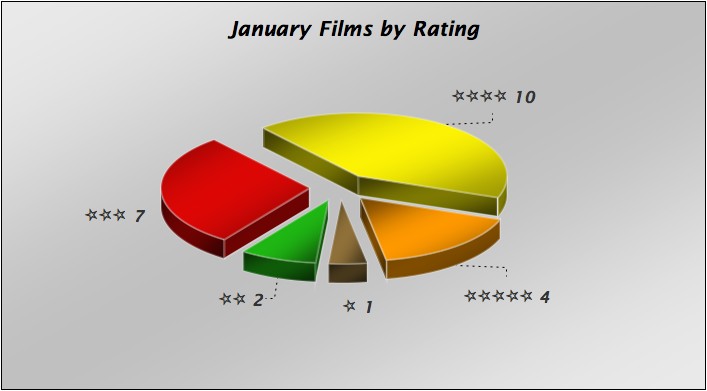
This final pie chart shows how I have rated the 24 films thus far. If I can manage to keep up this record-keeping, I'll be interested to see if the trend continues in which almost 90% of the films receive 3 stars or better. I guess it shows that I'm enjoying most of the movies I get to see!

My top five for the month of January

Wednesday, January 30, 2013

#24 The Spanish Civil War–Episode 6: Victory and Defeat (1983)


The termination of the war. The collapse of the Popular Front follows a sad but inevitable trajectory. Once the Nationalists were able to reach the east coast and split the Republican army in two, there remained few positive results left for the revolutionaries. As with all wars in the twentieth century, the final months of the war were filled with their fair share of atrocities committed by the victors while refugees attempted to escape and continue surviving in the midst of devastating poverty and the loss of their homes and homeland. The ones who were able to cross the Pyrenees and make it into France had only refugee camps awaiting them—little different from the concentration camps that were the destination of those deemed "enemies of the state" who were rounded up in Spain. A main difference, I guess, was in the camps in Spain there were still thousands of political executions waiting to happen throughout the next several years. Referred to as the "White Terror," these actions by Franco's Nationalists when added to the extrajudicial killings during the war would result in an estimated 200,000 of their fellow countrymen murdered for their beliefs. 

Such a sad chapter in history that is not so far removed from modern times. This series of documentaries does an incredible job of preserving the accounts of real-life witnesses who experienced the stories being recounted for posterity.

Monday, January 28, 2013

#23 The Spanish Civil War–Episode 5: Inside the Revolution (1983)


This episode, in contrast, explains the much more complex nature of the Republican side of the war. The different political parties that fought for their own beliefs and how conflicts arose between the neighboring factions and what that led to. There were such marked differences in political and social thought. The Popular Front was made up of anarchists, progressives, communists, syndicalists, agrarian-revolutionaries, socialists and members of the International Brigades. Unfortunately, the organization of such an agglomeration of entities was exceedingly difficult and resulted in inherent differences even up to the point of armed violence between the separate factions all belonging to the same Popular Front aligned against the fascist Nationalists. These stories comprise a sad but truly fascinating chapter in the history of Western Europe in the twentieth century. Fundamental to this unfolding experiment in social upheaval are terms such as: Revolution, Organization, Syndicalism, Collectivization, Cooperation, Libertarian Socialism, Anarchy, Fraternization with the enemy, Traitor, and unfortunately: Stalin and Trotskyist. It's unbelievably enticing to start asking "what if...?" Had the Soviet Revolution and the resulting Stalinist dictatorship not occurred, could the Popular Front have defeated Franco? Would the concepts of Socialist Revolution that were so fundamental in motivating the people have been understood or believed in without the Soviet example? Could Socialism without authoritarian dictatorship actually have succeeded in western civilization? The truth of the matter is that Stalin was more concerned with not coming into direct conflict with Hitler yet (another participant in the "politics of appeasement"), that his decisions in 37 and 38 regarding the Spanish Civil war basically decided the fate of the entire Spanish Popular Front and the Second Spanish Republic.

In Spain during almost three years, despite a civil war that took a million lives, despite the opposition of the political parties (republicans, left and right Catalan separatists, socialists, Communists, Basque and Valencian regionalists, petty bourgeoisie, etc.), this idea of libertarian communism was put into effect. Very quickly more than 60% of the land was collectively cultivated by the peasants themselves, without landlords, without bosses, and without instituting capitalist competition to spur production. In almost all the industries, factories, mills, workshops, transportation services, public services, and utilities, the rank and file workers, their revolutionary committees, and their syndicates reorganized and administered production, distribution, and public services without capitalists, high salaried managers, or the authority of the state.
Even more: the various agrarian and industrial collectives immediately instituted economic equality in accordance with the essential principle of communism, 'From each according to his ability and to each according to his needs.' They coordinated their efforts through free association in whole regions, created new wealth, increased production (especially in agriculture), built more schools, and bettered public services. They instituted not bourgeois formal democracy but genuine grass roots functional libertarian democracy, where each individual participated directly in the revolutionary reorganization of social life. They replaced the war between men, 'survival of the fittest,' by the universal practice of mutual aid, and replaced rivalry by the principle of solidarity....
This experience, in which about eight million people directly or indirectly participated, opened a new way of life to those who sought an alternative to anti-social capitalism on the one hand, and totalitarian state bogus socialism on the other.

Saturday, January 26, 2013

#22 The Spanish Civil War–Episode 4: Franco and the Nationalists (1983)


This episode focused on the nationalist side of the war. Who they were, what their beliefs were, and who their leader Francisco Franco was. 

After finishing my review of Episode 5, I realized that I had written so little for this review. The main idea that I contemplated during this episode that I would like to put down on paper is that the Nationalist side of the conflict was primarily based on three concepts: Traditionalism (societal stratification by classes, capitalism, domination of culture by the Catholic church, etc.), Patria (motherland), and Order. This final fundament of the fascist Nationalist cause was the primary difference between them and their opponents that allowed them to fight and win a military conflict. To form a functioning military, hierarchy, authority, obedience and subservience are fundamental. The anarchist revolutionaries on the opposing side with the support of individuality, free thinking, and state-opposition were the biggest deterrents to fighting a well organized military campaign. It is also why the dictator-authoritarian communist faction of the Popular Front were able to garner much of the power from their side, as they were much more suited for taking orders, carrying them out, and achieving military objectives. This together with the aide given by Stalin in the form of planes and munitions supplied with the objective of supporting the Soviet (Stalinist) version of Revolution. 

The story of the Nationalists and Franco is interesting but not nearly as fascinating as the Revolutionaries. Another interesting "what if...": if they had been able to defeat Franco and his form of fascism, how many years of upheaval would there have been in attempting to establish order following military victory? Would the libertarian-socialist principles of the Popular Front have been able to be converted into a successful peacetime government, and how would the hardships of coming out of a civil war have affected that? Would repression against Franquistas by the victors have been similar to what indeed was actually perpetrated by the fascists especially considering the policies of Stalin in the late 1930s. And most interestingly: what role would Spain have played in WWII?

#21 Mujeres al borde de un ataque de nervios (Women on the verge of a nervous breakdown) (1988)

Written and directed by Pedro Almodóvar.