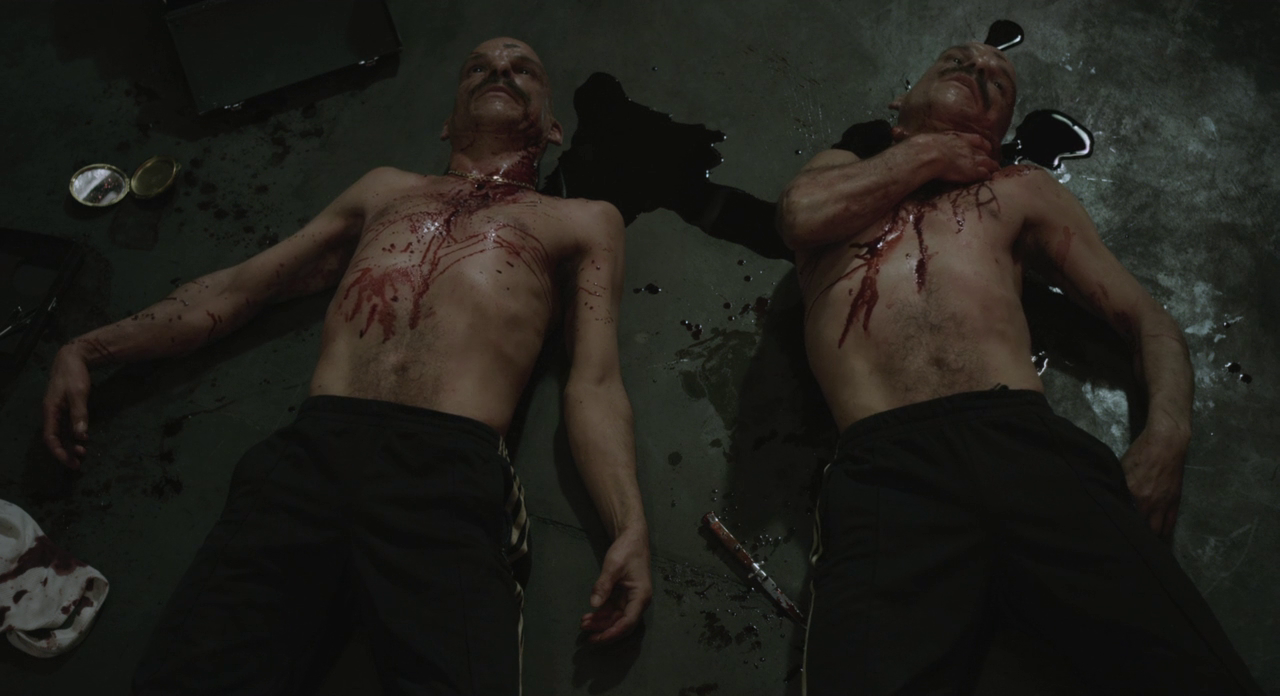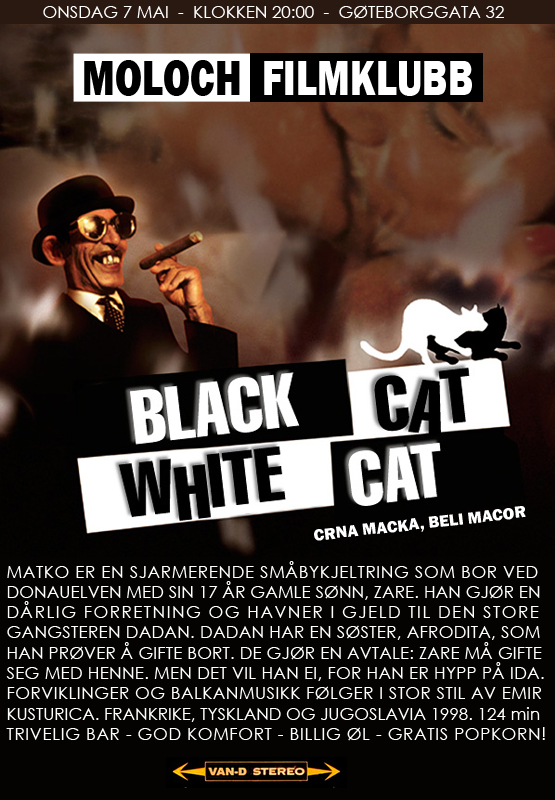
This was my first experience with Emir Kusturica. What a trip! To even get the slightest idea of the tone of this movie, just watch the youtube clip I have in this post. I know it lacks subtitles, but you don't necessarily need to understand the dialogue to get a feel for what this movie is like. I highly recommend it. It is chock-full of incredibly quirky and bizarre characters that are all ridiculously hilarious. I especially got a kick out of the ubiquitous flock of domestic geese hanging around and invading so many of the scenes. I can only imagine how crazy of an experience filming this gem would have been. I think that I will foray into Kusturica's weird world again to see what else there is to discover. Oh, and I can't forget to mention the lovely Branka Katić. It was very refreshing to see such an enchanting beauty appear in a comedy and not play the one-dimensional beauty/object of desire of a story. All of Katić's charm comes shining through as she is just another member of this crazy group of individuals who all come together to create such a wonderful and bizarre world. It really makes you wonder if life is just simply like that in the Balkans.
Showing posts with label Foreign language. Show all posts
Wednesday, February 27, 2013
Wednesday, February 20, 2013
#52 8½ (1963)
Federico Fellini.
This was the first time I ever saw this movie. And in 35mm in the theater, as well. I am so excited about this post and this movie, that every picture that I find on the internet I want to add to my post. I've restricted myself to only some of the best. Both movie posters I think are super cool. Then I have the two main actresses, Amouk Aimée, Guido's wife Luisa, and Claudia Cardinale, his muse Claudia. I also was extremely excited when I came across the animated gif of the dance scene with Mario and Gloria, which clearly was the inspiration for Tarantino's dance scene in Pulp Fiction with Travolta and Thurman, an obvious tribute to Fellini's 8½ if I ever saw one.
This movie is very difficult to write about, and I don't think I am going to try very much. I feel honestly blessed to have had the opportunity to see it in the theater even though it was a poor print and there was also a somewhat annoying older couple in the audience who laughed excessively during just about every scene. I think they were the kind of Seattlites who want to express to everybody how much they were understanding the movie by laughing at everything. You know, "we're so culturally aware and interesting. Not only do we go to 8½ in the theater, we want to make it clear that we know the film so much more than everybody else." To the point of at times repeating some phrase in italian that the character of the scene had just said with the air of like, "oh, how genius that is!" Regardless, it was impossible for me to come away from this film without thinking that it is truly one of the best films I have ever seen. And, I know that simply by its reputation as a film classic I was very hesitant to give it my approval. I guess I am very quick to think that movies are far too overrated. However, in this case, it was impossible not to adore this movie. I was completely enchanted by the actresses in this movie. Of course, the movie is about a film director struggling with his artistic voice and in particular with all the myriad women who occupy some part of his life. And Fellini does an incredible job of portraying them all. There is no way to watch this and not come away completely in love with women in all their incarnations. I was already so impressed with so many of the female characters already introduced at the point when Luisa, Guido's wife, shows up. Anouk Aimée instantly became one of my favorite actresses. And this was this first time I had ever seen her. The scene in which Guido sees her and follows her is incredible film-making at it's most basic. Her enchanting beauty and female strength was so immediately apparent to me, that I instantly fell in love with her. I was so entranced by Luisa and completely immersed by the movie that I couldn't have been rescued by anything that Fellini would do with it. And then he brought back into the picture Claudia. She had a very small shot early in the film that just gave you the idea she was going to be an insignificant extra in one of the strange dreams of Guido. But, no. He brought her back. And his portrayal of this sirena is too powerful to even try to describe in a silly blog. I only wish I could have seen the movie again immediately after it finished. Anyone who ever gets the opportunity to see this movie in the theater should legitimately feel great shame if they pass it up. I wish my meagre review could only portray a little bit how strongly I felt about this movie. 5 stars.
Monday, February 18, 2013
#50 Léolo (1992)
Written and directed by Jean-Claude Lauzon.
We decided to try this French-Canadian film based on a recommendation by a friend. It is a strange and bizarre ride. It took me two days to finish it, and by the end, I wasn't certain I was any better off than before I started. It was difficult to discern any type of chronological or even sequential storyline. There is a boy, Léolo, as the main character, who seems to escape from his strange and quirky family by his secretive hobby of writing. About the only really memorable characteristic of Léolo is that he believes that his mother was impregnated accidentally by the sperm of an Italian when she falls into a cart of tomatoes. Thus he really is not a Canadion named Leo, but an Italian named Léolo Lozone. There are some slightly humorous sequences, but overall this movie is difficult to enjoy over the entire hour and 40 minutes.
Saturday, February 16, 2013
#46 — #47 Oscar Nominated Shorts: Documentary (Part 2) (2012)
#46 Redemption — Jon Alpert & Matthew O'Neill
#47 Open Heart — Kief Davidson & Cori Shepherd Stern
This post gets a label of 5 stars primarily for this last film: Open Heart. I believe it will be the winner of the Oscar, and it deserves to be. It was a very touching story worth viewing for anybody. Even though it is only a short-length film and therefore harder to come-by, I recommend it over about 90% of the feature-length films I have on here.
Monday, February 11, 2013
Friday, February 1, 2013
Saturday, January 26, 2013
#20 Rashomon (1950)
Akira Kurosawa.
This is truly a classic in the history of film. This was the first time I have seen it, as I hadn't ever really gotten into Kurosawa despite knowing a little about his work (primarily Seven Samurai) and hearing his name mentioned as one of the top directors of all time.
Rashomon offers a great philosophical dilema. The movie begins with three men seeking shelter from the rain in a dilapidated building. The priest and woodcutter have just been witness to the trial of the notorious bandit Tajomaru and are retelling the tale. The story is quite simple. A samurai and his wife were traveling through the woods when confronted by Tajomaru. The woman is violated and her husband ends up dead. The dilema comes from the retelling of the story, as three different witnesses, the bandit, the wife and the dead husband (through a medium), all relay conflicting accounts of what occurred. Whose story is to be believed? How was the samurai killed? Why are there such drastic differences in the three versions of the same event? The final straw comes when the woodcutter reveals that he actually was present in the woods throughout the entire affair. When his account of the events offers a fourth version, we are struck with the complexity of what should be a simple straight-forward crime story. The earnestness of the woodcutter, along with the fact that the whole story of the trial is coming from him (with the priest as a corroborator), makes it difficult to question the validity of his account. However, when it is revealed that he hasn't been entirely truthful about every detail, a whole array of larger questions arise about perception, subjectivity, partiality, point-of-view and memory. I can clearly understand why this movie is considered a classic. And, I also wonder why today's movie-making industry doesn't generate many films that invoke mental contemplation from its viewers. Is film losing its place as an artform and becoming solely a commodity?
Wednesday, January 16, 2013
#11 Holy Motors (2012)
By Leos Carax.
This is a difficult movie to write about. It really needs to be seen. I tried to choose several different photos to try and convey the variety of bizarre sequences in this movie, but the few I've selected only represent a small fraction of the total. It is a french movie that essentially deals with acting. The main character, Monsieur Oscar, played by the versatile Denis Lavant (I think "versatile" is an understatement), is an actor who is ferried around in his limousine/dressing room to the various "jobs" he has to do during a typical work day. From a street-begging old maid to a trained assassin, to a sewer-dwelling elf, to an elderly man on his death bed, to an action-movie star in which his job entails performing fight scenes and love-making scenes all in a motion-capture suit. The movie definitely could be interpreted to delve into the question "what is acting?" or "what does creating cinema really mean?" However, these arguments only barely entered into my perception of this movie, as there doesn't appear to be an opinion or point of view that is being forced on the viewer. The viewing experience, for me, involved a lot more appreciation for the varying scenes and images, the strange interactions between the characters, and the great amount of creativity that went into the making of this movie. The result is a great feeling of "I wonder what is going to happen next!!!" I guess whether or not that makes it enjoyable or "entertaining" is up to each individual viewer.
4 stars.
Wednesday, January 9, 2013
#7 - Hannah Arendt (2012)
By Margarethe von Trotta. Tour de force performance by lead actress Barbara Sukowa.
Incredible work!
A must.
Incredible work!
A must.
We chose to see this one because it will be the opening night film in SIFF's Women in Cinema mini-festival. And indeed, Hannah Arendt is an incredible woman.
Labeled a "self-hating Jew" by her contemporary "intellectuals", Ms. Arendt apparently initiated the necessary and wonderfully difficult debate over the Holocaust and the roots of the evil that caused it. The meat of the movie starts when Hannah, a well-respected German-Jewish emigrant philosopher, concentration-camp survivor, and author of "The Origins of Totalitarianism", is asked to report for the New Yorker on the trial of recently arrested Nazi chief Adolf Eichmann in Jerusalem. Her highly controversial report correctly identifies the crime as too huge for any individual to be held responsible and Eichmann as simply too miniscule a cog in the totalitarian machine–a participant in the "final solution" without individuality in the least–even to the point of not being able to think. He, in fact, only acted according to the oath he had taken to always obey the fuhrer, and never acted of his own volition or even to think his own individual thoughts. He never killed anyone. All he did was load the victims onto the trains. What happened to them after that wasn't his responsibility, and therefore none of his concern. He was just a correctly functioning lever in a well-oiled machine.
The main contention her Israeli and American colleagues and friends had with her report stemmed from her delving deeper in her attempt at understanding the complexity of the phenomenon and her failing to admit the complete inculpability of the Jewish leaders. They too had fallen into a system in which their individuality had been taken from them. The victims, as the perpetrators, were unable to veer out of the confines of the machine of the totalitarian system. There was no freedom of choice, freedom to act, or freedom of thought. They only did what they were told. This system wasn't only in Germany. It pervaded all of Europe. Her detractors never forgave her for this betrayal. However, to her, these issues had to be brought up and examined. We all know what people who fail to understand history are destined for. Very much the intellectual, she adequately defended herself by explaining her position on Eichmann, "trying to understand him is not the same as forgiving him." If only more historians were like her...
Truly gut-wrenching, both sides of this argument are so terribly painful. As her close friend and strongest admirer admonishes her at the end with tears in his eyes, "you act like one of the superior Germans lecturing us inferior Jews! You forget that if you hadn't escaped the camp, they would have killed you too!"
Sunday, January 6, 2013
Subscribe to:
Posts (Atom)